Native 30FPS vs Artificial 60FPS

Native 30FPS vs Artificial 60FPS

AdrianH

Administrator
Let's have a gaming discussion....

It's been announced that Avowed is being released next year at 30FPS, and previously Starfield was released at a stable 30FPS before being updated with a 60FPS mode later on. Recently Black Myth Wukong has was released with a 60FPS mode, but it turns out they are "faking" it as Black Myth Wukong is using artificial frame generation to hit the 60FPS target creating other technical issues.

I believe this frame-gen approach has been implemented for one of two reasons (or both).
  1. The game is too taxing and without frame-gen, it will not hit the 60FPS unless the resolution is dropped significantly.
  2. The publisher wants the game out sooner (show me the money) and there is no time to optimise for 60FPS right now. So they may release a fix later, which may be impossible seeing the issue is input related, and the frame generation happens at after game has processed input and rendered.

What do you guys think about this? Should games be marketed at 60FPS when it's not native but using artificial frames to hit that target framerate that cause other issues? I get the feeling that the developer/publisher were worried about having a backlash if they didn't release the game with 60FPS, so they "faked" it.


For reference....

As it turns out, though, Digital Foundry has identified an additional performance mode problem that we never quite picked up on. According to their analysis, Wukong actually makes use of frame generation tech in order to close in on its 60fps target. Basically, frame generation does exactly what its name suggests — it artificially provides more frames per second to give the impression of a smoother visual experience.

However, in Wukong's case, the frame generation results in increased input lag. Essentially, you're playing the game at around 30fps — it's just that the frame generation makes it look like you're sitting pretty at 60. Inevitably, this means that you'll run into moments where you'll swear that you pressed the dodge button, or hit L1 to take a sip of your health-restoring drink — but the input simply doesn't register.

 
I've been fond of Frame Generation on PC, especially when using pathtracing.

In Cyberpunk with Pathtracing on my setup (RTX4090) I tested two configurations out :
63~70FPS before frame gen -> 93~100FPS after, this is with DLSS Performance (1080p internal)
~40FPS before frame gen -> ~70FPS after, this is with DLSS Quality (1440p internal)

Big difference in gameplay. The former is so much smoother and more responsive for an FPS title.
The latter, not very good. You can feel more lag and see more issues in motion (despite DLSS quality having a higher internal resolution which should make it look better).
And this is all with NVIDIA's implementation using crazy efficient Tensor Cores and Optical Flow Accelerator, the FSR 3.1 software-based solution is even worse.

Frame Gen for consoles is only good when the regular 30fps and 60fps modes are running well, then implement the mode with frame generation to give users an uncapped mode that targets 80+ for VRR displays.
 
In Cyberpunk with Pathtracing on my setup (RTX4090) I tested two configurations out :
63~70FPS before frame gen -> 93~100FPS after, this is with DLSS Performance (1080p internal)
~40FPS before frame gen -> ~70FPS after, this is with DLSS Quality (1440p internal)

My knowledge in this field is limited.

My understanding was that the primary use of DLSS and FSR was to increase the FPS by scaling up a lower resolution.

So with Adrian's Awesome game...

1) Runs at 40FPS at 1440p.
2) Runs at 60FPS at 1080p.

So I render the game in 1080p and let the upscaler increase the 1080p to 1440p but still keep the 60FPS. No frame were generated, only the actual resolution was increased. Note: These numbers aren't accurate, but to get my understanding across 😊

When did this framegen come into play because I am guessing this is exactly the same as interpolation on a TV, generating artificial frame that ultimatly have artifacts? @KenMasters
 
Last edited:
My knowledge in this field is limited.

My understanding was that the primary use of DLSS and FSR was to increase the FPS by scaling up a lower resolution.

So with Adrian's Awesome game...

1) Runs at 40FPS at 1440p.
2) Runs at 60FPS at 1080p.

So I render the game in 1080p and let the upscaler increase the 1080p to 1440p but still keep the 60FPS. No frame were generated, only the actual resolution was increased. Note: These numbers aren't accurate, but to get my understanding across 😊

When did this framegen come into play because I am guessing this is exactly the same as interpolation on a TV, generatong artificial frame that ultimatly have artifacts? @KenMasters

Correct.

Frame generation generates artificial frames and the higher the framerate was originally, the less chance of artifacts in the generated frames.

So that's why 30->60 with frame generation is worse than 60->90 despite them both only increasing the FPS by 30. When done correctly, you have much less latency than turning on interpolation on a TV.
 
Games aren't an equal trade-off between framerate and resolution, it depends what the game is doing with those cycles. Some titles will not hit 60 even with drastic cuts, because the main things occupying the CPU are not graphics related (in fact the GPU might even be relatively untaxed), physics and AI for example. In these cases, to hit 60, frame gen is a useful tool (as those frames are generated by the untapped resources of the GPU).

The higher the native framerate, the better the artifacts inherent in the generated frames are hidden - conversely the slower paced a game, the better you can get away with lower base framerates.

As far as "fake" frames and such things are concerned, games are all fakery of one sort or another. Get the balance right and it doesn't matter to me either way.
 
Last edited:
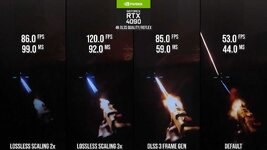
I do believe frame gen does introduce input lag (up to 70ms or so), so keep that in mind. It should be fine for SP games.
 
I do believe frame gen does introduce input lag (up to 70ms or so), so keep that in mind. It should be fine for SP games.

DLSS Frame Gen is about 10-15ms, which makes sense as it's the only one actually hardware accelerated.
I've used it extensively on my 4090 and I use it for everything outside of online FPS games like COD.

FSR3 Frame Gen though, closer to 40ms. Lossless scaling is much worse, sometimes over 55ms. If Sony were to lean on it, they need the hardware for it on the PS6.

-HEVC.mp4_snapshot_07.33_%5B2024-07-03_12.41.16%5D.jpg
 
Back
Top Bottom