Space

1737551926503.png
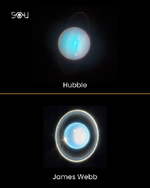
Uranus, as seen by Hubble and the James Webb Space Telescope! Here's what's different
Hubble's images of Uranus, primarily taken in visible light, presented a relatively featureless blueish sphere. The rings were faint and not well-resolved, largely appearing as a blur around the planet. This limited view failed to capture the intricate details of Uranus's ring system, which includes 13 known rings. Hubble's capabilities were constrained by its focus on visible wavelengths, making it difficult to discern the finer aspects of the rings and their dynamic interactions with the planet's atmosphere.
In contrast, JWST employs advanced infrared imaging techniques that allow it to penetrate Uranus's thick atmosphere and reveal much more detail. Its recent images showcase not only Uranus but also its rings in stunning clarity.
Notably, JWST successfully resolved the elusive Zeta ring, a faint and diffuse ring closest to the planet, which was not clearly visible in Hubble's observations. The JWST captures multiple infrared wavelengths (1.4, 2.1, 3.0, and 4.6 microns), providing a comprehensive overview of both the rings and the atmospheric features of Uranus.
The polar cap appears more prominent as Uranus approaches its 2028 solstice, showcasing seasonal variations that were previously unobserved with Hubble.

secretsofuniverse.in
 
Last edited:
Here are some space and astronomy channels on YouTube I subscribe to. The 2 Astrum channels I enjoy the most.

Astrum

Astrum Extra

Kosmo

Space Matters

SEA

V101 Space
 
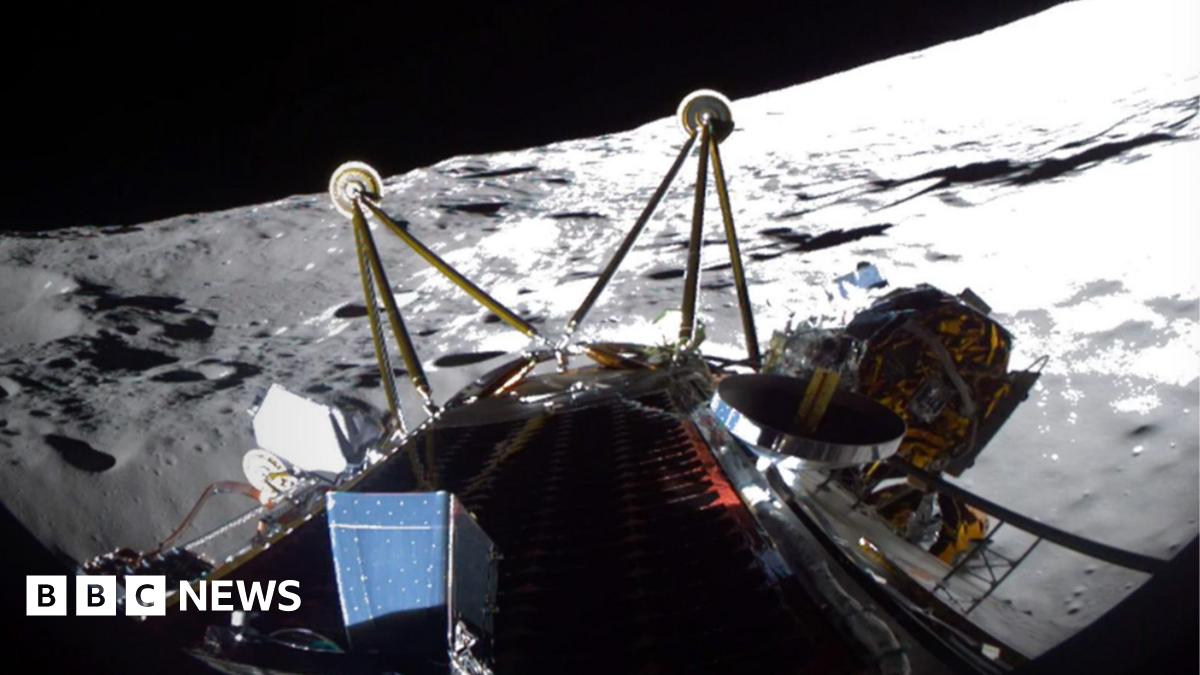
A private US company says it has landed a spacecraft close to the Moon's South Pole, carrying scientific instruments including a hopping robot and the first lunar mobile communications antenna.

But Intuitive Machines said it had yet to confirm the "orientation" of the spacecraft, called Athena, and was working to confirm its condition.

.....

 
A private US company says it has landed a spacecraft close to the Moon's South Pole, carrying scientific instruments including a hopping robot and the first lunar mobile communications antenna.

But Intuitive Machines said it had yet to confirm the "orientation" of the spacecraft, called Athena, and was working to confirm its condition.

.....

That hopping robot sounds interesting, I do hope they manage to get it out of the lander if it is indeed on it's side.
 
The subject of today’s NASA/ESA Hubble Space Telescope Picture of the Week is the stunning spiral galaxy NGC 5530. NGC 5530 is situated 40 million light-years away in the constellation Lupus (The Wolf). This galaxy is classified as a ‘flocculent’ spiral, meaning that its spiral arms are patchy and indistinct.

While some galaxies have extraordinarily bright centres where they host a feasting supermassive black hole, the bright source near the centre of NGC 5530 is not an active black hole but instead a star within our own galaxy, only 10 thousand light-years from Earth. This chance alignment gives the appearance that the star is at the dense heart of NGC 5530.


1746093893990.jpg

 
So, moon pass is back on track for early March...

I understand it takes time to do things safely, but man this is taking long for us to get back to our little satellite. Makes the achievements of the 60's all the more impressive.
 
Back
Top Bottom