The Solar / Inverter / Power thread

The Solar / Inverter / Power thread
Soooooo....

They will put 5 on 1 MPPT on a single string facing North-West (optimal point, but limited roof space)
and then 9 on 1 MPPT on a single string facing North-East (next best)

The JA Solar panels are half cells, so according to the sparkie, shade from my chimney (only really in Winter) won't bring down the whole string of 9 panels, it will just have a 20%-30% affect.... I hope he is right... 'cos we don't want to split that into a string of 4 and 5... the voltage from 4 panels is below the required threshold.

Inverter and batteries installed... my decision to increase to 14 panels means the panels go up tomorrow or Monday (depending on stock availability)

Load shedding in 45min... but I have full batteries so shouldn't feel it.
 
Soooooo....

They will put 5 on 1 MPPT on a single string facing North-West (optimal point, but limited roof space)
and then 9 on 1 MPPT on a single string facing North-East (next best)

The JA Solar panels are half cells, so according to the sparkie, shade from my chimney (only really in Winter) won't bring down the whole string of 9 panels, it will just have a 20%-30% affect.... I hope he is right... 'cos we don't want to split that into a string of 4 and 5... the voltage from 4 panels is below the required threshold.

Inverter and batteries installed... my decision to increase to 14 panels means the panels go up tomorrow or Monday (depending on stock availability)

Load shedding in 45min... but I have full batteries so shouldn't feel it.
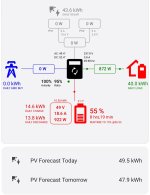
It's working quite well overall... I forced them to put 6 panels on 1 string facing NW and 8 panels on 1 string facing NE (the directions and roof space available to me) I've done some tinkering and I can peak at almost 7kW of power generation.

Already I know I should've gone for a 3rd battery - right now my house is using 2kW, all supplied by the panels, and the batteries are full, it could easily handle triple that as the sun is in optimal position - but the power has nowhere to go.

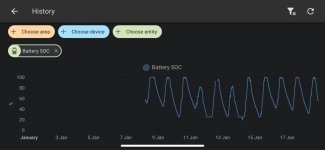
Gonna experiment tomorrow with letting my battery run down further than usual (have not gone below 60% yet)... I'm going to let it go down to 35% and see if I can get through the night (almost completely) without Eskom...

Is there any advice with regards to optimal treatment of the batteries? Is it bad to leave them fully charged? Bad to use the power from them very day? Bad to run them down to 30% ? (I know they shut-off at 20% as configured right now).

1702552663193.png

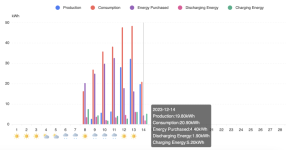
Trying to keep the purple bar down as much as possible.

Yesterday we used 48Kwh and only paid Eskom for 16 :)
 
@SauRoN since you're online now... can you comment on the two messages above please?

I've tinkered quite a bit and generally very happy with the system. Definitely want a 3rd battery, I'm already 90% off grid if I manage things daily, and about 80% off grid if I set and forget based on history/experience. Adding a WiFi timer for the geyser was also a big plus - so when the sun is strong, I use that available power, and when it isn't, we just plan properly around it. (Of course if a shower is needed, screw the savings, we let Eskom charge us a little).

Still a bit unsure on whether I can charge faster than 0.3c (I know I can, but should I?), likewise, should I let the batteries go down to 35% or keep them above 50%? Is it good or bad for them to sit at 100% for extended periods?

Those JA Solar panels are excellent, all 14 should max out at 7.7kW but I've regularly seen it peak over 8k

Have only once caused the inverter to overload, learnt from it, won't happen again :) my sizing was good (even with electric oven/stove/geyser/aircon), but 10kwhr of battery storage could definitely do with 50%-100% more.

I've even started looking at switching to a PHEV hybrid or full electric car - but that's another discussion - depreciation is a killer on them!

I’m firmly of the belief that you use what you paid for otherwise why did you bother buying it?

As long as you stick with what the manufacturer dictates for DoD to maintain warranty you are all good.

Which should be impossible to cock up anyway if using Canbus (percentages instead of voltages) as their own BMS should restrict it.

I run mine down to 20-25% different times of the day as mine cuts out at 15% so the extra 10% is there for load shedding.

You’d need to run them at 100% constantly for weeks on end before it will make any difference and then it will be a 0.5% capacity loss over a year more than normal.

The whole notion of looking after batteries is laughable. All that effort and then you also lose in not using the capacity only to have it maybe last 5% longer over 10 years.

It’s honestly not worth worrying about. Use the **** out of them and bargain on replacing them in ten years either which way.

You’ll also find it rarely stays at 100% for very long anyway. Only people without solar need to be concerned with that where they only use the batteries during load shedding.

The only thing I would pay attention to are the charge and discharge rates and stick to the recommendation from the manufacturer, but even that I’ve found is inconsequential with inverter settings in many cases and just managed by the BMS itself.
 
Last edited:
Also the thing is even with mine set to 25% the reality is more often than not it doesn’t drop below 40% anyway.

d0ea1a6c78d098ef61bd77cd801066f7.jpg
 
133b846af9ef14df730ff36d653f6d52.jpg

Always nice when it’s such a good solar day you turn everything on to use as much as possible and still piss some power away.

If it wasn’t for the stupid meter replacement cost I would be feeding back to the City of Cape Town.
 
6.3 kW Canadian Solar.
8 kW Sunsynk inverter
4 x Dyness 4.8 kWh batteries but ultimately 16
,3 kWh real capacity.
I have nearly the same, though 10kWh batteries.

Moving to Her*anus to a smaller place, so thinking Sunsynk 5kW this time, the price is pretty good. Not sure about battery yet. Will leave the panels for a few months later once finances recover from the move.
 
I’m firmly of the belief that you use what you paid for otherwise why did you bother buying it?

As long as you stick with what the manufacturer dictates for DoD to maintain warranty you are all good.

Which should be impossible to cock up anyway if using Canbus (percentages instead of voltages) as their own BMS should restrict it.

I run mine down to 20-25% different times of the day as mine cuts out at 15% so the extra 10% is there for load shedding.

You’d need to run them at 100% constantly for weeks on end before it will make any difference and then it will be a 0.5% capacity loss over a year more than normal.

The whole notion of looking after batteries is laughable. All that effort and then you also lose in not using the capacity only to have it maybe last 5% longer over 10 years.

It’s honestly not worth worrying about. Use the **** out of them and bargain on replacing them in ten years either which way.

You’ll also find it rarely stays at 100% for very long anyway. Only people without solar need to be concerned with that where they only use the batteries during load shedding.

The only thing I would pay attention to are the charge and discharge rates and stick to the recommendation from the manufacturer, but even that I’ve found is inconsequential with inverter settings in many cases and just managed by the BMS itself.

Thanks man, I'm a sucker for confirmation bias... and that is exactly how I felt! I'm gonna use the **** out of it too :)

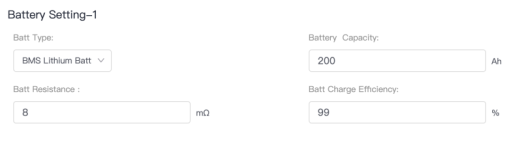
As for charge rates, my installer (I'd give him a B- in terms of knowledge) insisted that 0.3C is the way to go for these Shoto's, for longevity etc (so 60amps for my two batteries). But the guy that came out to do the SSEG (yeah, I paid extra to do what most people say you shouldn't do) said I can pump it up to 100amps easily... they can handle it just fine and even more, but he finds many installers leave the default settings. But since my batteries are often full from the sun before 10am on a good day, I don't actually worry too much about that. Maybe in Winter it will be different.
 
I have nearly the same, though 10kWh batteries.

Moving to Her*anus to a smaller place, so thinking Sunsynk 5kW this time, the price is pretty good. Not sure about battery yet. Will leave the panels for a few months later once finances recover from the move.

If I redid it how I would have had 2 x 5kW rather than 1 x 8kW.

When these batteries die I’m putting in a single 40kWh monstrosity and never worrying about capacity or Eskom again.
 
It will depend on your prepaid meter.

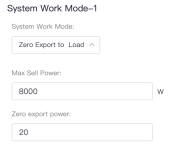
I’ve dropped mine down to 5W and no issues.

You’ll know it’s gone wrong if your prepaid meter trips.

I'll try the same... I'm with Conlog and knew before hand that I needed to contact them for codes that should prevent the prepaid from tripping, was just too scared to go below the installer's recommendation - it's a tiny difference in Eskom draw, but I hate the waste.

Are your reports standard Sunsynk? I like them... I've been using SolarmanPV (Business version) and recently the updated DeyeCloud service, and it's decent, but neither tick all the boxes.

Nah that’s all from Home Assistant.

Pretty much never use the Sunsynk stuff unless I want to change something.
 
Thanks man, I'm a sucker for confirmation bias... and that is exactly how I felt! I'm gonna use the **** out of it too :)

As for charge rates, my installer (I'd give him a B- in terms of knowledge) insisted that 0.3C is the way to go for these Shoto's, for longevity etc (so 60amps for my two batteries). But the guy that came out to do the SSEG (yeah, I paid extra to do what most people say you shouldn't do) said I can pump it up to 100amps easily... they can handle it just fine and even more, but he finds many installers leave the default settings. But since my batteries are often full from the sun before 10am on a good day, I don't actually worry too much about that. Maybe in Winter it will be different.

60amps per battery or collectively?

That does seem quite low if it’s collectively.
 
Nah that’s all from Home Assistant.

Pretty much never use the Sunsynk stuff unless I want to change something.

Did you have to install monitors in front of each item? I've been using Smart Life just to control basic remote functions with smart plugs and a geyser switch, but no aggregation of data which I'd like to do at some stage, and nothing else is hardwired in.


60amps per battery or collectively?

That does seem quite low if it’s collectively.
Collectively... so 0.3c on 200ah of batteries... the 3rd party installer was going on about not trusting Shoto - but he is talking from his ass, because he wanted to sell me Volta and the solution provider matched the Deye to the Shoto and everyone else I've spoken to swears by the reliability of Shoto (there was a small batch 2yrs ago that apparently had a faulty BMS, but they were sorted and swapped under warranty). I'll admit the Shoto's aren't pretty... industrial like your Pylons

Checked the specs, they recommend 0.5C charge and discharge, with a max of 1C - so I can easily push it. Just need to keep the temps under 35 degrees... which the battery seems to manage on its own.
 
Back
Top Bottom